
Autographe MVP Roadmap
“Minimum viable product” is one of the most abused phrases in software. For Autographe, it has a precise definition, and I will hold myself to it as much as I can. Simply, the Autographe MVP is the smallest thing that a real prose writer could actually use for a brief writing session without missing his good old word processor or professional prose writer tool.
Concretely the MVP can:
- Open, edit, and save a Markdown file: real multi-line editing with a visible and correctly-placed cursor.
- Move and edit modally: a working
NORMAL/INSERTdistinction and enough of theSPCleader keymap to feel like Doom Emacs’s. - Render prose beautifully: proportional shaping (if the expression is right) of text, not a rigid character grid, and basic Markdown syntax styling.
- Save invisibly to git: every save creates a background snapshot, the writer could also save (read commit) milestones, or special forks of his work, all without seeing any of git’s intricacies.
- Stay out of the way: which-key hints and a discoverable command palette, for minimal writer-tool latency.
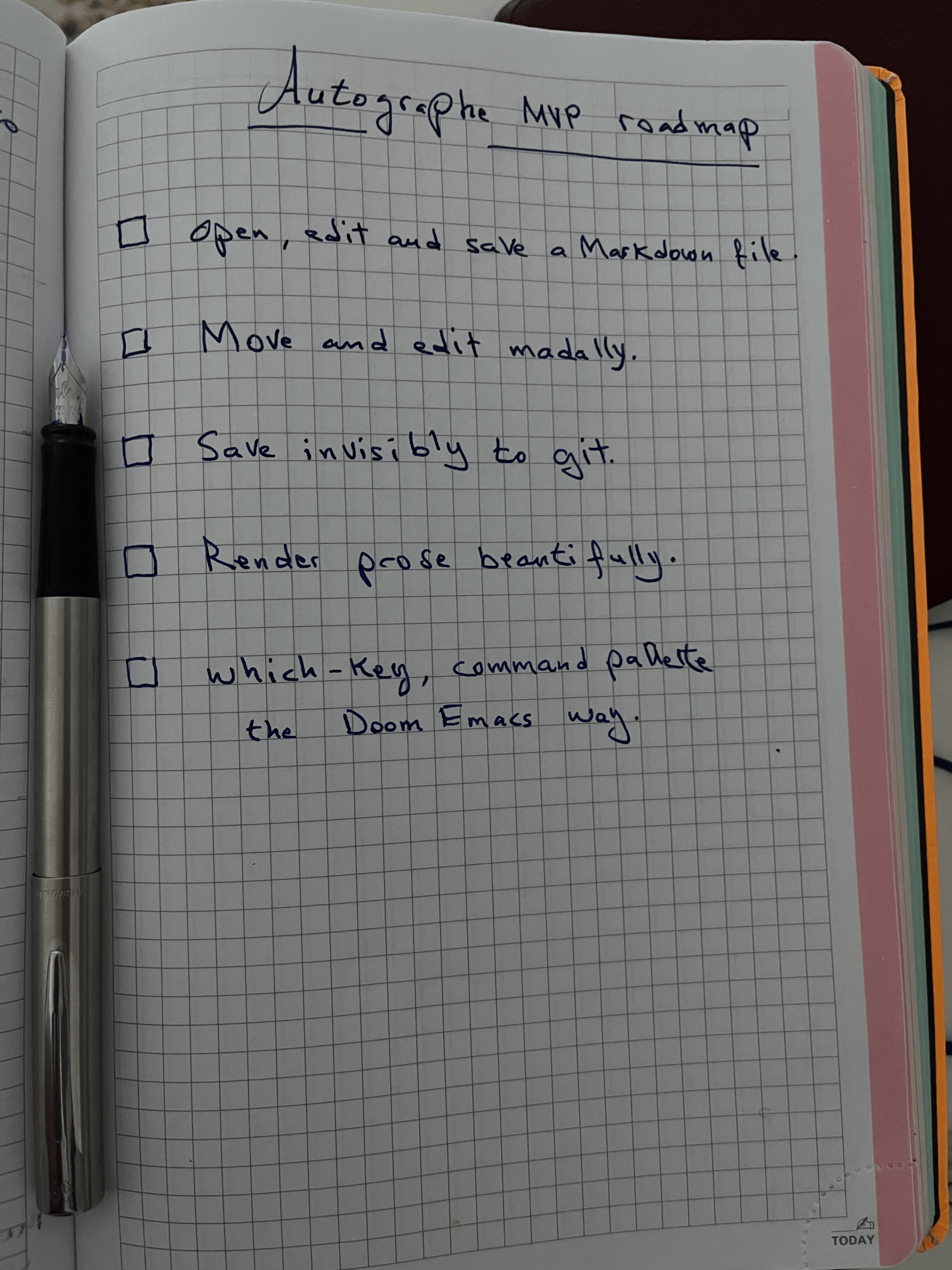
The Autographe MVP roadmap.
Everything else is post-MVP and explicitly out of scope. I name the boundary now as my north star to ship as fast as I can. The discipline of a named MVP is what lets a solo founder ship, and this very five-point roadmap will keep me ruthless about scope.
Speaking of “shipping fast”; I’m not in a hurry to get the product out in the traditional way, because the aim is also for me to learn while building, and boy there are things to research and learn about; both in regards to the tech stack and the writers craft. For example, some of the technical questions I want to answer before or while building the app:
- How text editors are built and do I need to start from scratch?
- What should I research before start building: I know that text rendering and editing is hard, I’ve read one or two things on the subject once, but how come we already have so beautiful and efficient text editors since decades? There have to be some known “knowns” to start from.
- Will the core of the app be a simple combination and orchestration of some libraries or will I have to dive deep into text manipulation specific data structures and algorithms?
- Autographe needs low latency as a feature so that the gap between keystrokes and pixel is imperceptible, but how to model all of that the right way from the start?
- How should I approach modal editing à la Doom Emacs and Spacemacs: will it be a state machine? How will that map to the gui level I’ll be using?
- how much “work” is already handled at he OS and framework levels? How much do I need to build myself?
At this stage, the question list has no limit, every question has layers of related questions.
Honestly, the vision is blurry; there are plenty of prose text editors, not all of them are successful commercial products, prose writers have already their favorite tool, the technical domain is hard!
Certainty of death? Small chance of success? What are we waiting for?
— Master Gimli
Exciting times ahead. Let’s get into it.